Thursday, 9 March 2017

Aliens in Their Own Country: Election of 1917 and the Conscription Crisis in French Canada


Poster for Voting Yes for Concsription vote. 

            Conflict between French and English Canadians is a common theme found in Canadian history; going as far back as the Conquest.  These two nationalities that make up the Canadian identity have differed culturally, mainly in religious and lingual forms, and continued to be at odds with one another after Confederation.  In the years leading up to the First World War, English and French Canadians fought over Ontario’s Regulation 17, which restricted the teaching of French in schools in the province.[1]  This incident caused divisions between French and English Canadians, in which the 1917 election and the crisis over conscription continued to divide these two groups during the First World War.   Both the election and the conscription crisis singled out French Canadians and led to rioting within the province of Quebec.  The goal of this paper will be to examine these two events and show how they served to further divide French-English relations.
            On 3 August 1914, Great Britain declared war on the German Empire and Austria-Hungary, which meant Canada, as one of the other dominions in the British Empire, was expected to participate in the conflict.[2]  Since the mid-nineteenth century the Canadian government relied on a small army made up of volunteers in times of crisis.[3]  It was thought at the beginning of the war that English and French would have united in fighting along the Western Front in France and Belgium when the first Canadian contingent of 36,267 soldiers set out for Europe.[4]  On the surface, this number suggests a large number of Canadians rushed to volunteer but, as Margret Levi reveals in her article “The Institution of Conscription”, upon closer inspection, it can be seen that the majority of members in this first wave were British-born while only twenty-seven percent were English Canadian and three percent French.[5]
            Despite this, Canadians across the country fully supported the war.  The streets of Montreal were crowded with people cheering while French Canadian newspapers proclaimed that French and English Canadians were now united in the war against Germany and Austria-Hungary.[6]  Protestant and Catholics, such as the Archbishop Paul Bruchési, backed the British Crown and argued that the war was “just and needed to be fought.”[7]  This enthusiasm began to waver as the war progressed.  Modern weaponry, poisonous gases and poor conditions in trenches led to mounting casualties: 61,000 deaths and 173,000 wounded from the 620,000 men Canada mobilized over the course of the First World War.[8]  As the death toll rose, the amount of enthusiasm Canadian men had for volunteering was in decline by 1917.[9]  The French-Canadian province of Quebec was seen as responsible for the lack new recruits as it contained 1.6 million of the two million French Canadians that lived in Canada, of which only 14,100 had volunteered in the Canadian Expeditionary Force.[10]  Calgary’s Member of Parliament R. B. Bennett, the cabinet member appointed to overseeing the recruitment, reported that in one case reported that a million and a half men volunteered, of whom only five hundred thousand were “considered military prospects.”[11]  The most enthusiastic were British immigrants who had just arrived in Canada while French Canadians became more supportive as the war progressed.[12]   The need for more manpower in Europe prompted Prime Minister 
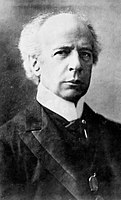
Robert Laird Borden cph.3b31281.jpg
Canadian Prime Minister
Sir Robert Bordon,
Conservative
Robert Borden to introduce in House of Commons the Military Service Act (M.S.A.) on May 18, 1917 and it faced much opposition.[13]  Henri Bourassa of the Nationalist Party, with backing from prominent members of the French Catholic Church and members of the Quebecois press, argued that enforcing conscription on French Canadians would turn them into “a revolutionary people.”[14]  Bourassa’s argument, though extreme, was not inaccurate.  French-Canadian nationalist leaders published literature against conscription, calling for all Canadians to actively protest the bill; while in Quebec anti-conscription marches descended into riots and the “harassment of soldiers and recruitment officers.”[15]  After the bombing of the residence of Lord Atholstan, owner of the pro-conscription newspaper Montreal Star, police discovered that the group the Dynamitards, had also planned on attacking other targets including Parliament and even had assassination plans for the Prime Minister and other government officials.[16]  Some newspapers, such as the Protestant Presbyterian and Westminster, tried to be sympathetic to the French Canadian reaction.[17]  They argued that unlike English Canadians, who reserved strong loyalty to Britain and its empire, French Canadians remained loyal only to Canada and “[t]o die abroad would be to die in exile.”[18]  The article went on to argue that had Canada been directly attacked, French Canadians would have gladly gone to arms against any foe.[19]
Wilfrid Laurier 1917.jpg
Sir Wilfred Laurier
Opposition Leader,
Liberal
            The former prime minister and leader of the official opposition, Wilfred Laurier, opposed the idea of conscription and pressed for a referendum over the matter, which was denied by Borden.[20]  The possibility of an election could be dangerous for Borden’s Conservative party, who had been hesitant to call by-election for twenty seats in order to avoid losing their majority.[21]  In 1915, the Opposition reluctantly agreed to delay elections by one year by Borden’s request.   In order to insure his party’s victory and the passing of his conscription bill, Borden knew he would need to form a coalition government with Laurier’s Liberal Party.  It was an option that had been pushed by denominational newspapers throughout 1917 and appeared to be the best way to both save the Conservatives and prevent an English-French split over the matter.[22] 
            Between May and October 1917, Borden set to work trying to form a coalition cabinet that would meet the approval of Laurier.[23]  The proposed cabinet was made up of equal parts Liberal and Conservative while Borden would remain as Prime Minister.[24]  The Liberal party was divided over the proposal when Laurier presented it, among those against included William Lyon Mackenzie King, who thought an election on conscription would be deadly for the Liberal Party.[25]  Upon returning to the Prime Minister from his meeting with the Liberal caucus, Laurier told Borden he would only support conscription if a referendum or election were conducted before it was implemented.[26]
            While all this was happening, the M.S.A. was voted on in Parliament.  On August 29, 1917, the bill was passed with a vote of 119 to 55, of which thirty-seven Quebec Liberal Members of Parliament voted against it.[27]  The M.S.A. conditions stated that all men between the ages of twenty and forty-five would be drafted into military service, though men in “vital industries or who were needed on the farms” would be exempted from having to serve.[28]  As Laurier remained unsupportive of the act and the Opposition in disorder over whether or not to side with their leader, Borden saw this as a safe chance to call an election.[29]  The announcement of the bill’s passing was met with rioting in Montreal; leaving one person dead and several injured, alongside the anti-conscription violence spreading across the rest of Quebec.[30]
            After one last failed attempt to form an agreement with Laurier, Borden met with the Governor General, the Duke of Devonshire, on October 31 to dissolve Parliament and to call for an election that would occur in December 1917.[31]  Borden had a very simple plan for winning the election: “bring over enough Liberals without Laurier to enable him to go to the people.”[32]  To insure success in the election, two emergency bills were introduced before Parliament: the Military Voters Act (M.V.A.) and the Wartime Elections Act (W.E.A).  The M.V.A. expanded suffrage to both men and women (including women who were close relatives) enrolled in the Canadian forces, regardless of the length of time they had been living in Canada.[33]  Though the bill would allow for overseas ballots to be cast, this would only be based on the political party and not the candidate, soldiers would pick their riding and the ballot would be mailed to the designated polling station.[34]  An issue with this act was government officials were given much leeway in where ballots could be sent, often leading to ballot box-stuffing in some ridings.[35]  The second bill, the W.E.A., proved to be more controversial due to its anti-immigrant nature.  Designed by the Secretary of State, Arthur Meighen, the W.E.A. disenfranchised immigrants who had come from countries that were at war with Canada, including Germans, Austrians, Czechs, Slovaks, Poles, Ruthenians, Galicians and immigrants from Russian territory that were incorporated into the German Empire.[36]  Anyone who had come from these countries and had been naturalized after 1902 were to be disenfranchised and be exempt from conscription unless they had a male family member serving in the military.[37]  Interestingly enough, many of those who had lost the right to vote had arrived in Canada during the previous decade under Laurier and Clifford Sifton’s great immigration campaign.[38]  To defend himself from critics, Borden argued that it was necessary to disenfranchise immigrants from enemy countries as “it would be unrealistic to conscript recent arrivals… and expect them to fight against their homeland and family” and for that same reason “they should not be entrusted with a vote.”[39]  In addition to these bills, gerrymandering was committed to change the riding boundaries in Ontario, Nova Scotia, and New Brunswick to weaken Liberal influence, while twenty-two seats were created in the west for population growth and to take influence away in Quebec.[40]
            Borden’s plan to form a Unionist Party was disastrous for Laurier, who saw many of his fellow Liberal members leave his side to support Borden’s coalition.[41]  The result of the election when the polls closed on the evening of December 17, 1917 saw Borden’s Unionist Party, made up of a mix of Conservatives and pro-conscription Liberals, with one hundred fifty-three seats while Laurier’s Liberals won eighty-two.[42]  Of the one hundred fifty-three seats that the Unionists had won, only three were from Quebec, the rest of the province supporting Laurier or Bourassa.[43]  Though the Unionists had won, Anglophones were not entirely supportive, giving 841,944 votes to Borden and 744,899 to Laurier.[44]  For the first time since Confederation, Conservatives no were no longer dominant in Quebec, who had become more alienated by Borden’s war policies and felt that the Prime Minister had placed his loyalties toward Great Britain instead of Canada.[45]  Since the 1917 election with the exception of the election of 1930, the Conservative Party was unable to win more than thirty-five percent of the five Quebec seats.[46]  While Quebeckers were unhappy with the results made by Borden, there was little discussion of separation.[47]  Though Joseph-Napoleon Francoeur put forth a motion in Quebec’s legislative assembly calling for secession, it was quickly debated and overruled by January 1918.[48]  At the same time, French newspapers scoffed the thought of splitting while Catholic Church officials made their position being against it very clear. [49] 
            The introduction of conscription led to desertion among Canadian men, of which sixty percent were French Canadian.[50]  This large number of evasions and the strong opposition toward force enlistment by French Canadians led to further divisions between themselves and English Canadians, who believed that the former was not doing their part in fighting the war.[51]  The Canadian government began to enforce the M.S.A. on 1 January 1918 when it called for 400,000 men from across the country to enlist.[52]  The government also sent Dominion Police officers into Quebec to find, arrest and prosecute anyone suspected of avoiding the draft.[53]  These actions prompted many angered people to arm themselves and to riot in Quebec City.[54]
            The Quebec Easter Riots began on Thursday, March 28, 1917 when Dominion Police arrested a man at a bowling alley for failing to prove he had an exemption certificate.[55]  A mob of angry people traveled to the police station in the St. Roch district of the city and pressured the police to release the man and then proceeded to vandalise the building interior and assaulted several officers.[56]  In reaction, the Dominion Police inspector contacted Quebec City’s mayor, Henri-Edgar Lavigueuer, for assistance from the municipal constabulary but proved it to be pointless since the municipal police lacked the proper training to handle the matter.[57]
            On the following day, Good Friday, another man was detained by police for suspicion of draft dodging but was quickly freed when his exemption certificate was found at home.[58]  At the same time that day, rumours spread across of rioters planning to “attack all federal buildings in Quebec City.”[59]  The mayor called for Brigadier-General Joseph-Philippe Landry, whose men were stationed in the city, to remain to restore order in the event these rumours were true.[60]  The Canadian Government supported this request, citing that Landry’s forces were legally allowed under the Militia Act of 1868, which allowed for soldiers to “aid civil powers in times of crisis or emergency.”[61]  In addition to Landry’s troops, a thousand men were sent from Toronto and an additional three thousand from the west were sent by government order to ensure the riots would be stopped as quickly as possible.[62]  The reason the Canadian government sent so many English-speaking soldiers to Quebec City was because it believed it could not rely on French-Canadians, feeling that these francophone soldiers – especially those who had been conscripted – would be sympathetic and mutiny from their commanding officers to side with the rioters.[63]  At the end of the riot, four civilians had died while several soldiers had been wounded.[64] 
            In conclusion, the election of 1917 and the Conscription Crisis are two issues that served to alienate French Canada and Quebec from the rest of Canada.  The question of instituting mandatory service created a wide gap between English and French. The English felt that French-Canadians were not doing their share to serve in protecting the British Empire while French Canadians believed Canada had no part to play in the war and had no need to fight.  The election caused further issues by weakening the influence Quebec had by gerrymandering and the establishment of wartime laws to ensure Conservative victory, which led to end of Conservative dominance in Quebec.  To French-Canadians, Borden had betrayed Canada’s sovereignty to the British Empire by instituting the M.S.A.  Therefore, it is clear that French and English Canadians were at odds with one another and have a dynamic that has shaped Canadian culture and history.
Anti-conscription parade at Victoria Square.jpg
Anti-Conscription Rally, 1917

Pictures
https://en.wikipedia.org/wiki/Canadian_federal_election,_1917
https://en.wikipedia.org/wiki/Conscription_Crisis_of_1917
http://worldwaridocumentgallery.wikispaces.com/file/view/e-20020045-1509_a.jpg/310400884/e-20020045-1509_a.jpg

Bibliography
Argyle, Ray. “Blood and the Ballot: Democracy on Hold – The Federal Election of December 1917.” In Turning Points: The Campaigns that Changes Canada, 2004 and Before, edited by Ray Argyle, 155-179. Toronto: White Knight Publications, 2004.
Auger, Martin F. “On the Brink of Civil War: The Canadian Government and the Suppression of the 1918 Quebec Easter Riots.” Canadian Historical Review 89, no. 4 (December 2008): 503-540. Academic Search Complete, EBSCOhost (accessed October 29, 2014).
Dickinson, John and Brian Young. A Short History of Quebec. Montreal: McGill-Queen’s University Press, 2008.
Filley, Walter O. “Social Structure and Canadian Political Parties: The Quebec Case”. The Western Political Quarterly, Vol. 9, No. 4 (Dec., 1956), 900-914. http://www.jstor.org/stable/444505.
Heath, Gordon L. “The Protestant Denominational Press and the Conscription Crisis in Canada, 1917-1918”. Etudes D'histoire Religieuse 78, no. 2 (June 2012): 27-46. Academic Search Complete, EBSCOhost (accessed October 29, 2014).
Levi, Margret. “The Institution of Conscription”. Social Science History, Vol. 20, No. 1 (Spring, 1996), 133-167. http://www.jstor.org/stable/1171506.


[1] Ray Argyle, “The Federal Election of December 1917”, in Turning Points: The Campaigns that Changes Canada, 2004 and Before, edited by Ray Argyle, (Toronto: White Knight Publications, 2004), 159
[2] Ibid., 159.
[3] Margret Levi, “The Institution of Conscription”, Social Science History, Vol. 20, No. 1 (Spring, 1996), 147, http://www.jstor.org/stable/1171506.
[4] Ibid., 148.
[5] Ibid.
[6] Argyle, 159.
[7] Gordon L. Heath, “The Protestant Denominational Press and the Conscription Crisis in Canada, 1917-1918”, Etudes D'histoire Religieuse 78, no. 2 (June 2012), 39, Academic Search Complete, EBSCOhost (accessed October 29, 2014).
[8] Martin F. Auger, “On the Brink of Civil War: The Canadian Government and the Suppression of the 1918 Quebec Easter Riots”, Canadian Historical Review 89, no. 4 (December 2008), 506, Academic Search Complete, EBSCOhost (accessed October 29, 2014).
[9] Ibid., 506-507; Argyle, 161.
[10] Auger, 507.
[11] Argyle, 163.
[12] John Dickinson and Brian Young, A Short History of Quebec, (Montreal: McGill-Queen’s University Press, 2008), 254.
[13] Auger, 148.
[14] Levi, 148; Argyle, 164.
[15] Auger, 507.
[16] Ibid.
[17] Heath, 43.
[18] Ibid.
[19] Ibid.
[20] Levi, 148.
[21] Argyle, 161.
[22] Ibid., 163; Heath, 37.
[23] Argyle, 164.
[24] Ibid.
[25] Ibid.
[26] Ibid.
[27] Levi, 148.
[28] Argyle, 164.
[29] Ibid.
[30] Auger, 507-508
[31] Argyle, 164-168.
[32] Ibid., 165.
[33] Ibid., 166; Levi, 149.
[34] Argyle, 166.
[35] Ibid.; Levi, 149.
[36] Ibid.
[37] Ibid.
[38] Argyle, 166.
[39] Ibid., 167.
[40] Ibid.
[41] Ibid.
[42] Argyle, 167; Levi, 149.
[43] Auger, 508.
[44] Levi, 149.
[45] Walter O. Filley, “Social Structure and Canadian Political Parties: The Quebec Case”, The Western Political Quarterly, Vol. 9, No. 4 (Dec., 1956), 902, http://www.jstor.org/stable/444505.
[46] Ibid.
[47] Argyle, 178.
[48] Auger, 508.
[49] Argyle, 178.
[50] Levi, 149
[51] Ibid., 150.
[52] Auger, 508.
[53] Ibid.
[54] Ibid.
[55] Ibid.
[56] Auger, 508-509.
[57] Auger, 509.
[58] Argyle, 178.
[59] Ibid.; Auger, 509.
[60] Auger, 509.
[61] Ibid.
[62] Ibid., 512; Argyle, 178.
[63] Auger, 512.
[64] Argyle, 179.

Monday, 6 March 2017

Top 10 Canadian Prime Ministers of the past 150 years


Hey, Think Harper was the best Prime Minister?  or Trudeau Sr.?  or even Mackenzie or Macdonald?  Well, take a vote on my poll for best Prime Ministers the past 150 years of Canada!  Voting lasts till March 31, 2017 and will be then analysed in a new blog post for July 1st!  Don't wait like Mackenzie-King! Vote Now!  Just Click on the picture above to vote.

Thursday, 16 February 2017

Goodnight at the Vinyl Cafe: A Tribute to Stuart McLean


"In the meantime, look after yourselves and each other. And know that this isn’t goodbye. It’s just … so long for now." (Stuart McLean)
It is sad to hear of the recent passing of Stuart McLean, Canadian writer, producer, and host of CBC Radio's Vinyl Cafe, has really hit me.  Since high school, I had admired Stuart's calming ability to find magic and beauty in all the little things in life.  I was first introduced to Stuart McLean's work through an appearance he made at the Winnipeg Comedy Festival, telling the story of how a carrot inspired him to attempt drinking eight glasses of water a day (I recommend looking it up).

It's odd feeling so sad about some one I never knew or met, but at the same time, Stuart made everyone feel a connection with his work.  His characters like Dave and Morely became people that were part of our lives.  He reminded us of how we needed to slow down, running to the end of the journey would spoil the details and sights that you would see on the way.  No man could sum up this feeling than Stuart himself could:

"We do this thing. We open our hearts to the world around us. And the more we do that, the more we allow ourselves to love, the more we are bound to find ourselves one day ... standing in the kitchen of our lives, surrounded by the ones we love, and feeling empty, and alone, and sad, and lost for words, because one of our loved ones, who should be there, is missing. Mother or father, brother or sister, wife or husband, or a dog or cat. It doesn't really matter. After a while, each death feels like all the deaths, and you stand there like everyone else has stood there before you, while the big wind of sadness blows around and through you." (Stuart McLean, "Le Morte d'Arthur")

Sources
http://www.huffingtonpost.ca/2016/12/13/vinyl-cafe-suspended_n_13610260.html
https://www.ticketmaster.ca/Stuart-McLean-and-the-Vinyl-Cafe-tickets/artist/9232


Wednesday, 15 February 2017

Into the Fairy Lands: Chapter 6

Into the Fairy Lands
By J. R. Bennett
<Chapter V~*~Chapter VII>

Chapter VI
Parliament
~*~
The following morning everyone had to wake up early.  Alice was dressed in an Edwardian styled dress; she took less time getting ready the men!   Ed, Travis, and Zach had to dress in morning suits with starched collars and fronts.  Ed was able to slip quite easily into the suit, while Zach and Travis’ shirtfronts kept uncoupling from the back collar stud, not to mention they felt strangled by the heavily starched collars!
            Once ready, they went down to the entrance of the hotel to take a private car to a restaurant for breakfast.  It was empty for the most part with the exception of a few people at one table.  In one corner was a bar that was closed until the later part of the day where a waiter was wiping the brass on the bar with polish.  When he saw the group, the waiter quickly brought them to a table.
            While the group were conversing, waiting for their orders to arrive, Ed was scanning through his copy of the report and was scribbling, scratching and re-editing it in a frantic action.  Every time he would reach the last page, he would flip back to the beginning and revise the report again.
            No one knew what to say, Ed had been so over confident during their time in Newtown, but now he seemed tremendously nervous in Bathill.  His hands were shaking the whole time over breakfast.
            After breakfast, they climbed into another cab and taken to the main entrance of the Parliament.  The cab rolled along a cobble stone road, traveling through another set of gates to enter into a courtyard, where in the centre some maintenance workers cleaning an ancient canon on a stone platform.  When the taxi finally reached the end of the courtyard, it stopped before a long series of steps leading up to the doors.
            As Ed, Travis, Zach, and Alice walked up the stairs, they passed many of the same people from the day before.  Guthrie Bloom, who had a friend with him to escort Alice to the viewing gallery, quickly found them.  When Alice had left, Bloom gave the three men the information he knew on where the parties stood in supporting the report.
            “The Working Class, Liberals and the Unionists are still in favour, they’ll both be voting as a block.  The Methodist, they’re intending to vote against it as a block.  I still have no clue about the Conservatives though; they seem to keeping things quite secretive this time.”
            “Sounds like our work won’t be nearly as hard as I thought,” Ed said, sounding evermore relieved.

The chamber that both houses were to meet in was vast and heavily laid with woodcarvings.  Ed, Zach and Travis were directed to sit in a set of chairs on one side of the room.  The three men looked uncomfortable with the strong lights that were cascading hot radiance upon them.
            Alice stood up in the viewing gallery, watching the events unfold.
            Two pages opened the heavy oak doors to the chamber and two stewards entered.  Each steward carried a massive sceptre, one gold and the other silver.  Following the two stewards were the Prime Minister and Governor General of the Deltic Empire, each wearing fur gowns over their suits.  At this point, once the Prime Minister and Governor General had taken their seats, trumpets sounded as her majesty, Clair II, Queen of the Gallan-Gallet and Empress of the Deltic Empire entered the chamber, dressed strictly, in what was deemed acceptable for Parliament.  As the queen walked into the chamber, all the members of the Halls of Commons and Honours stood to attention and sang the Imperial Anthem, which was played by a brass band.
            The music died away and everyone sat in their places.  One of the stewards, dressed in a green gown with white trimming, stood and read from a roll of parchment: “On this day of our blessed Queen, we join for this closing of this session of Parliament.  We shall be hearing a presentation from the Order of the Four Keepers, followed by a speech from the throne before concluding this session.  Is their presenter within these halls?”
            Ed stood to attention. “I am!” he called back.
            “Have you your supporters?”
            “I do.”
            The members of the Deltic Parliament watched in attention as Ed spoke.  The facts of the matter were quite simple.  The city of Apothem had mysteriously vanished from the Finylands.  The accounts from those outside and from surviving recorded messages from within the city reported a large purple cloud descending upon Apothem.  The description of this cloud met the description of the cloud the Manookoo cult from Zeltic myth.  Other reports were claiming that the cloud was on route to the Gallan-Gallet.
            “What are you suggesting,” called a politician with the face of a bullfrog.
            “I am suggesting,” replied Ed, choosing his words carefully, “that our very empire is under threat from unknown forces.”
            “This is non-sense!” the frog-faced man cried.  “Are we to have our time wasted for some fairy story?  Are we to be sent up to our bed’s after the meeting is convened?”
            “Honorable speaker!” called Bloom from his side of the house.  “Might I remind the honorable member that it is this gentleman and his two companions who are giving the presentation and not himself?”
            The council broke out in to intense argument.  Half of the house was calling for immediate action while the other claimed Ed’s comments were merely fear mongering from the Order of the Four Keepers.  At last, her majesty arose.
            “Silence,” she bellowed.
            The chamber became quiet.
            “It appears,” the queen continued. “We are at a standstill.  Would you not agree Prime Minister?”
            “It appears so.”
            “And our Governor General?”
            “I quite agree your majesty.”
            Clair II turned her attention to Ed, Zach and Travis.  “Young man, how long do you think we will have until this cloud appears here?”
            “I would estimate, based upon what happened in Apothem, at the earliest a week or as late as a month.”
            “Then parliament will not close,” proclaimed the queen.  “I order both houses to meet in session tomorrow and discuss the matter.  If what this young man says is true, I would advise clear sober thought on the matter.”
            The three were lead out of the chamber by an armed steward.
            “That went well,” said Zach to no one in particular.
            “Yes,” agreed Ed.  “That is why I suggest we skip town while the going is good.”
            “What?”
            “Did you not see the look on the face of Augustus Maverton?”
            “Who.”
            “Maverton – the guy with the ugly face who asked what I was suggesting.”
            Travis and Zach then gave a look that suggested they both did and did not understand what their friend was saying.
            “Maverton,” continued Ed, with an air of gravity, “is head of the Royal Secret Police.  He does not like people suggesting the empire is under threat, that’s his job.  I won’t be surprised if we are arrested tonight.”
            “So we’re leaving?” asked Travis.
            “Yep.” Answered Ed.  “Right now actually.  Bloom has arranged a cab for us and our things will be at the station, that’s who I was meeting with last night in the lobby.  We shall be riding the Evening Star, it’ll have us home by morning.  It’s a good thing I never submitted our real names.”
            “What do you mean?” inquired Travis.
            “I usually go by pseudonyms.  You know, John Marrick, Brian Wilson, Joseph Bennett, stupid names to cover up my appearances.”
            At the three departed for the doors, Travis realized something important.  “What about Alice?”
            “Oh, she’ll be fine.” assured Ed.  “Her escort is a member of the Order.  Bloom has given him strict instructions to take her to the station when we left the room.”

The four friends sat in their compartment of the train.  The enchanted coaches served them their tea and supper as the train made its long cumbersome voyage to Newtown by going north to the moorlands and then south along the Tashford River. 
            Over supper, Ed shared the story of the Canker the fallen star who was captured by Kon-luk, the warrior of the Deltics.  Kon-Luk wanted to fight the ghost of the warrior Lomassmay, in order to gain the strength of a thousand men, and hoped that in capturing a star he would be able to wish the ghost before him.  Canker tricked Kon-luk into freeing him by telling him the ghost of Lomassmay would only appear to those who proved themselves honourable.  In order to prove he was an honorable warrior, Kon-luk was told by Canker to free him, and the ghost of Lomassmay would appear.  In doing so, Kon-Luk never got his wish, nor did he ever see the ghost of Lomassmay.

            It was dark now and the stars were beginning to come out.  Ed sat staring out at the black abyss as everyone else slept.